

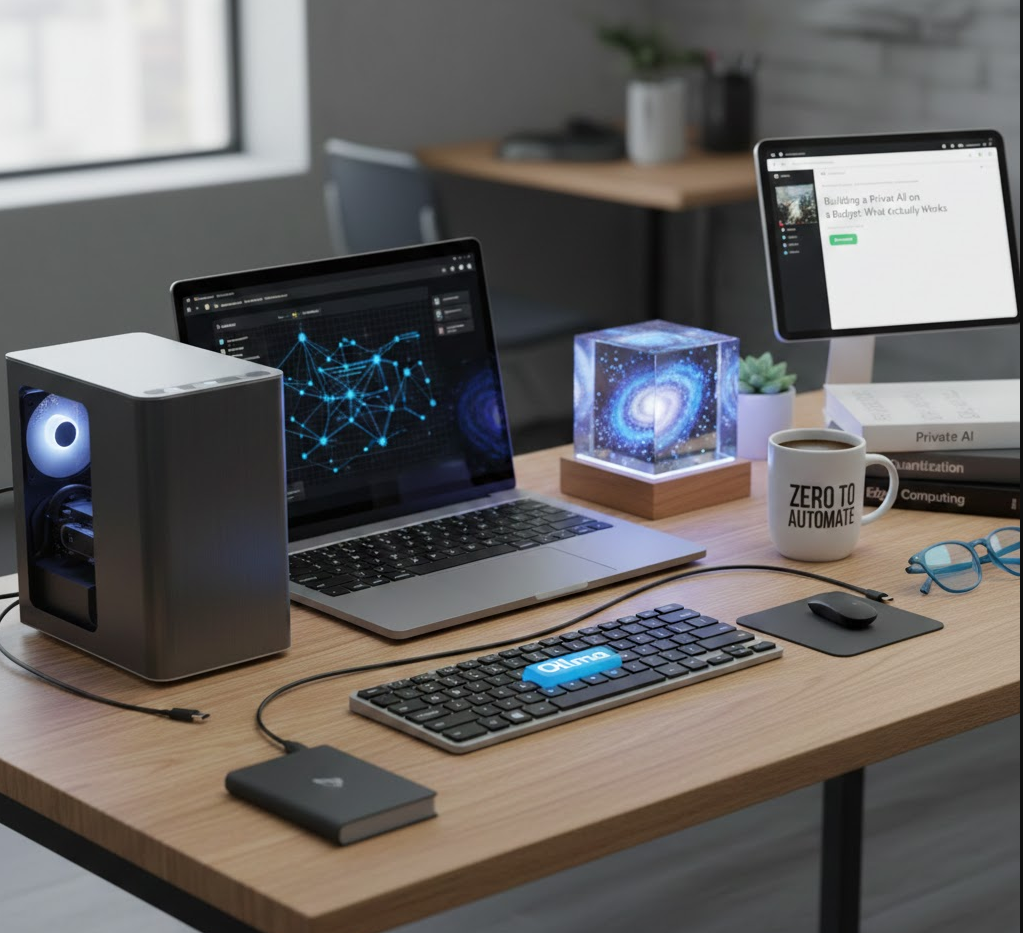
Data privacy isn’t a compliance checkbox anymore — it’s a financial imperative. IBM’s 2023 Cost of a Data Breach Report put the average breach cost at $4.45 million, a 15% increase over the prior three years. When you frame private AI deployment against that number, the economics shift quickly. Keeping your data off third-party inference servers stops being a philosophical preference and starts looking like basic risk management.
The good news: the barrier to building a genuinely capable private AI stack has never been lower. Here’s what the landscape actually looks like.
If you’re new here, you might want to check out my Absolute Beginner’s Guide to AI Automation before diving into the local setup.
The Open-Source Foundation Is Stronger Than You Think
The single biggest misconception about private AI is that it requires expensive proprietary software. It doesn’t. Hugging Face alone hosts over 500,000 models, 250,000 datasets, and 250,000 Spaces — a staggering library of production-ready assets that would have cost millions to develop in-house just five years ago. For most use cases, your model isn’t the hard part or the expensive part.
What you’re really paying for is infrastructure and integration. That’s where smart architectural decisions pay off disproportionately.
Model Quantization Changed the Hardware Equation
Running a capable large language model privately used to mean either a rack of GPUs or an expensive cloud contract. Quantization has meaningfully disrupted that calculus. By reducing the numerical precision of model weights, modern quantization techniques allow sophisticated models to run on 8–16GB of VRAM or system RAM — hardware that’s available in a mid-range workstation or even a gaming PC.
The llama.cpp project deserves particular credit here. Its CPU-first inference approach means you don’t need a discrete GPU at all for many workloads. For a small team running internal document analysis, summarization, or classification tasks, a single well-configured machine can handle the load without a cloud bill attached.
A Practical Hardware Framework for Budget Deployments
Rather than chasing the latest GPU, consider matching hardware to your actual inference requirements:
- For light, intermittent workloads — a modern CPU with 32GB of RAM and a quantized 7B–13B parameter model will cover a surprising amount of ground. Think internal search, document Q&A, or classification pipelines.
- For sustained or concurrent inference — a mid-range consumer GPU (RTX 3090 or 4070-class) with 16–24GB VRAM dramatically improves throughput and unlocks larger models without requiring enterprise hardware.
- For teams that want zero on-premise maintenance — self-hosted cloud instances on providers like Hetzner, Vultr, or Lambda Labs offer GPU-equipped VMs at a fraction of AWS or Azure pricing, with the data sovereignty benefits of a dedicated environment.
The Real Cost Comparison
It’s worth being direct about the math. A mid-spec private inference server — purpose-built machine, one-time cost, modest electricity overhead — typically pays for itself within months when compared to per-token API fees at production volumes. Beyond the cost crossover, you gain something that API access fundamentally cannot provide: certainty about where your data goes.
For regulated industries, that certainty has compliance value that’s genuinely difficult to price.
Where to Start
If you’re new to private deployment, the most efficient path is: pick a quantized model from Hugging Face suited to your task → deploy it via llama.cpp or Ollama → evaluate performance against your actual workload before investing further in hardware.
The community tooling around local AI has matured considerably. Frameworks handle the complexity that once required specialized ML engineering, and the documentation across the llama.cpp GitHub repository and Hugging Face’s model cards is detailed enough to get a working prototype running in a day.
The private AI stack available today would have been unimaginable on a budget just two years ago. The combination of open-source model availability, quantization advances, and efficient inference engines has effectively democratized deployment that was once the exclusive domain of well-funded teams. The $4.45 million breach cost figure is a useful reminder of what’s at stake — but the more interesting story is how little it now costs to meaningfully reduce that risk on your own infrastructure.
Joseph
Digital creator and entrepreneur focused on building online businesses through automation, content, and hands-on learning. From fishing blogs to AI-powered workflows, he’s always experimenting with new ways to simplify life and create income online. Driven, curious, and self-taught, Joseph uses his journey through boxing, fatherhood, and overcoming challenges as fuel to grow and inspire others along the way.